
If you run marketing for a local service business—plumbing, HVAC, dental, landscaping, home cleaning, legal, wellness, you name it—you’ve probably felt this specific kind of frustration:
You know blogging can bring leads. But every time you sit down to write, you hit the same wall: What should this post cover, in what order, and how do I make it actually useful (and not just “content”)?
That wall is usually not a “writing” problem. It’s an outlining problem.
And today, that problem gets louder. Search is more intent-driven, readers are more impatient, and generic “SEO filler” content is easier than ever to spot—and ignore. Google’s documentation consistently emphasizes people-first, helpful content and clear trust signals—especially when automation is involved.
This guide teaches you a practical workflow for how to use AI to draft blog post outlines for local services—without turning your blog into a robot factory.
You’ll learn how to feed AI the right context, shape outlines around local intent, and add the human ingredients (experience, proof, and specificity) that actually win trust and lead.
Table of Contents

What You’ll Learn in This Guide
- How to turn real customer questions into high-intent local blog topics
- A step-by-step AI outlining workflow that produces publish-ready structure (not fluff)
- How to choose the correct post format by matching search intent and expectations
- How to create local outlines that feel written by someone who actually serves the community
- Two practical AI blog outline examples you can adapt for your own services
- The most common mistakes with AI outlining (and how to fix them fast)
- How to turn your best prompts into a reusable system your team can repeat
Why Outlines Matter for Local Services
Local service blogging has a unique job: it’s not trying to entertain the whole internet. It’s trying to help a specific person in a specific area make a decision.
That means your blog post has to do three things at once:
- Answer the question clearly (so readers don’t bounce).
- Prove you’re a real, trustworthy local provider (so they believe you).
- Guide the reader to the next step (so the post produces leads, not just pageviews).
A good outline is the “skeleton” that holds all three.
A weak outline creates predictable failure modes:
- The post meanders, repeats itself, and never lands the point.
- The content stays generic (so it doesn’t build local trust).
- The call-to-action is awkward or missing (so the traffic doesn’t convert).
AI can help—because outlining is pattern-based. But AI only becomes useful when you treat prompting as system design, not “write me a blog post.”
Also, search fundamentals still matter. Google’s Search Essentials emphasizes creating helpful content, using the words people actually search in prominent places (like titles and headings), and keeping links crawlable so your site can be understood and discovered.
So we’ll build a workflow that respects both: humans first, structure second, SEO third (but baked in).
Service Page vs Blog Post: Don’t Outline the Wrong Thing
Before you prompt anything, get this distinction straight:
Service pages
- Target: “I need a plumber in Austin now.”
- Intent: transactional
- Goal: book a call / request a quote
- Structure: benefits, process, pricing expectations, trust signals, FAQs, service area
Blog posts (for local services)
- Target: “Why does my faucet squeal?” / “How often should I service my HVAC?”
- Intent: informational (often with a commercial shadow)
- Goal: educate → build trust → move toward booking
- Structure: clear explanation, options, risk/when to call a pro, local relevance, next steps
If you outline a blog post like a service page, it reads like an ad.
If you outline a service page like a blog post, it reads like homework.
This guide is about blog outlines that support local services—especially TOFU (top-of-funnel) informational content—without losing the business purpose.
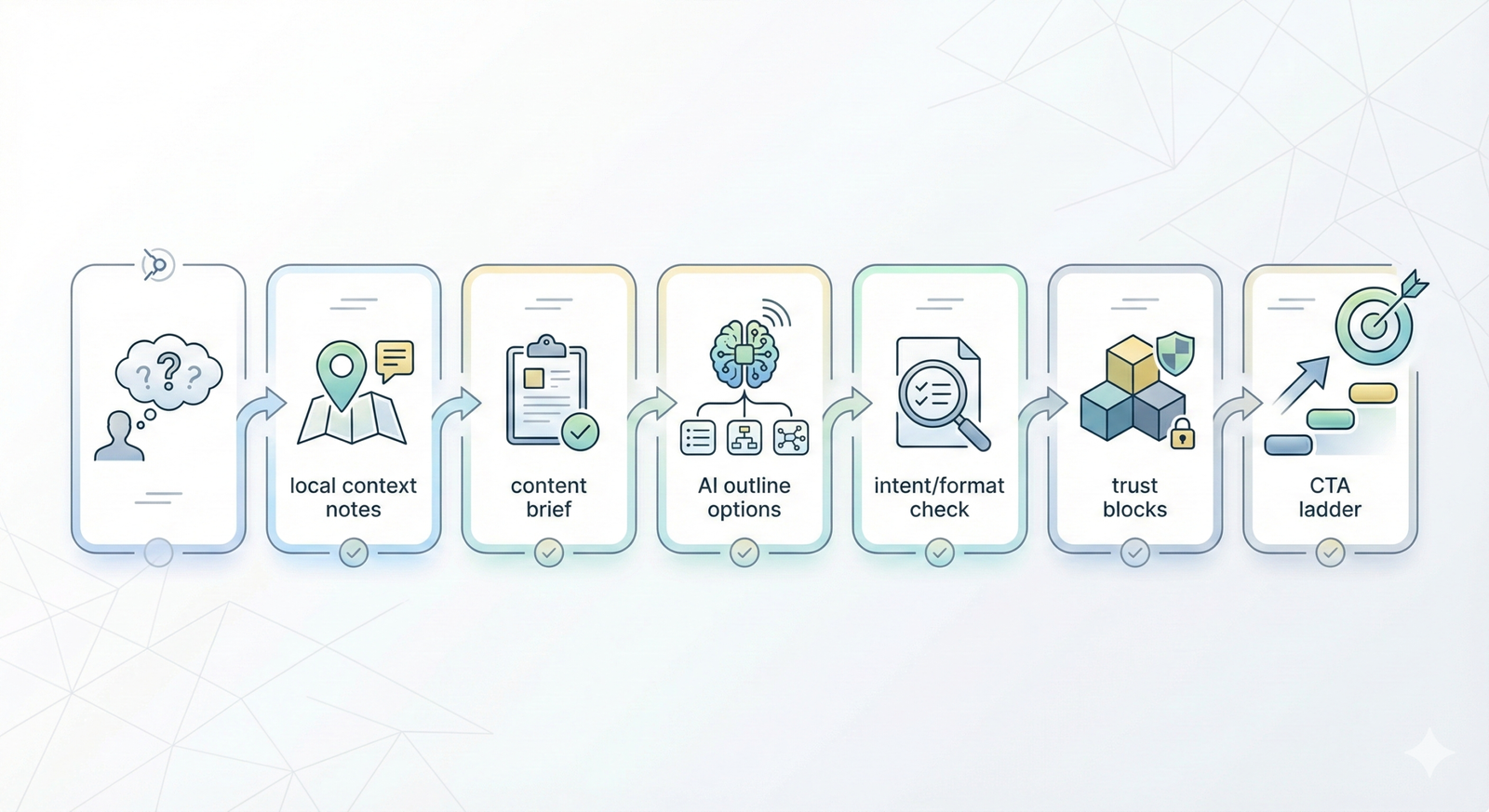
How to Use AI to Draft Blog Post Outlines for Local Services: The 7-Step Workflow
This is the core system. You can do it in 20–40 minutes per post once you get the hang of it.
Step 1: Pick one “job-to-be-done” (not a broad topic)
Bad topic: “Plumbing Tips.”
Better topic: “How to prevent pipes from freezing in older homes.”
Best topic: “How to prevent pipes from freezing in [your climate/home type] + when to call a plumber.”
Even if you publish broadly, your outline must focus narrowly.
A simple rule: One post = one main question + one main outcome.
Write this sentence:
“After reading this, a local homeowner should be able to ______.”
Examples:
- “Diagnose the likely cause of low water pressure.”
- “Know whether a buzzing AC is urgent.”
- “Understand what influences dental implant timelines.”
This sentence becomes the anchor of your outline.
Pick one primary outcome (or your outline bloats fast):
- Reduce fear/uncertainty (plain-English explanation)
- Help self-diagnose (symptoms → likely causes)
- Set expectations (variables, timelines, factors—not promises)
- Compare options (repair vs replace, DIY vs pro)
- Prepare to book (what to ask, what happens next)
Step 2: Collect local-intent inputs (the “reality fuel”)

AI is great at structure, but it’s not inside your business. Feed it real-world context.
Make a quick “Local Reality Notes” list:
- Top 3 customer questions you hear weekly
- Common misconceptions you have to correct
- Local variables: weather, housing style, regulations, seasonal patterns
- Your service constraints: response time, emergency vs scheduled, what you don’t do
- Trust signals you can mention: years in business, certifications, warranty approach, safety practices
If you skip this step, your outline will feel like it was written by someone who has never picked up a wrench, answered a phone call, or dealt with a real customer at 7:30 pm.
Customer Language Sources (10-minute sweep):
- Call logs/receptionist notes (what people literally say)
- Google Business Profile Q&A
- Common estimate templates and repeat questions
- Your reviews + competitor reviews (phrasing patterns)
- Technician field notes (“we see this a lot in older homes…”)
Small-Site Reality (Why this workflow is built for small teams)
If your site is small (a solo owner, one marketer, or a tiny team), your constraint is usually time—not ideas.
This workflow reduces outlining to a repeatable checklist so you can spend your limited hours on what AI can’t fake:
Real photos, local stories, accurate safety notes, and trustworthy next steps.
Step 3: Build a one-page content brief (human first)
Your brief should be short enough that you’ll actually use it.
Mini Brief Template
- Audience: (homeowner / property manager / parent / small office owner)
- Location context: (humid climate / cold winters / older neighborhoods / service-area only)
- The question: (one sentence)
- The “safe answer”: (what’s true most of the time)
- The “danger zone”: (when it’s urgent / when DIY becomes risky)
- Proof you can include: (photos, checklist, examples, a short story, before/after)
- CTA: (book inspection/request quote/call for urgent issues)
This brief is what makes your outline not generic.
Step 4: Prompt AI for 2–3 outline options (then choose)
Now we prompt. Don’t ask for “the best outline.” Ask for options with different angles.
Example prompt (conceptual)
You are outlining a blog post for a local service business.
Topic/question: [insert]
Audience: [insert]
Local context: [insert bullet list]
Requirements:
- Provide 3 different outline options (each with H2/H3 headings)
- Match informational intent (TOFU) but include a helpful next step
- Include a short “DIY vs call a pro” section
- Include an FAQ section with 5 questions
- Avoid fluff, avoid fake statistics, avoid medical/legal claims
- Keep it specific to local service realities
You’ll be surprised how often outline option #2 is the winner—because it lands on a more natural structure.
Example 2:
Prompt Template (4-part structure):
Goal: Draft 3 outline options for a TOFU blog post about [topic] for a local [service type].
Context: We serve [city/region]. Audience is [homeowners/property managers/etc.]. Local realities: [bullets].
Expectations: Include a quick answer, step-by-step section, DIY vs pro, local considerations, and 5 FAQs. Avoid fluff and invented statistics.
Source (your notes): Use these field notes as facts: [bullets]. If uncertain, ask clarifying questions or present ranges/factors only.
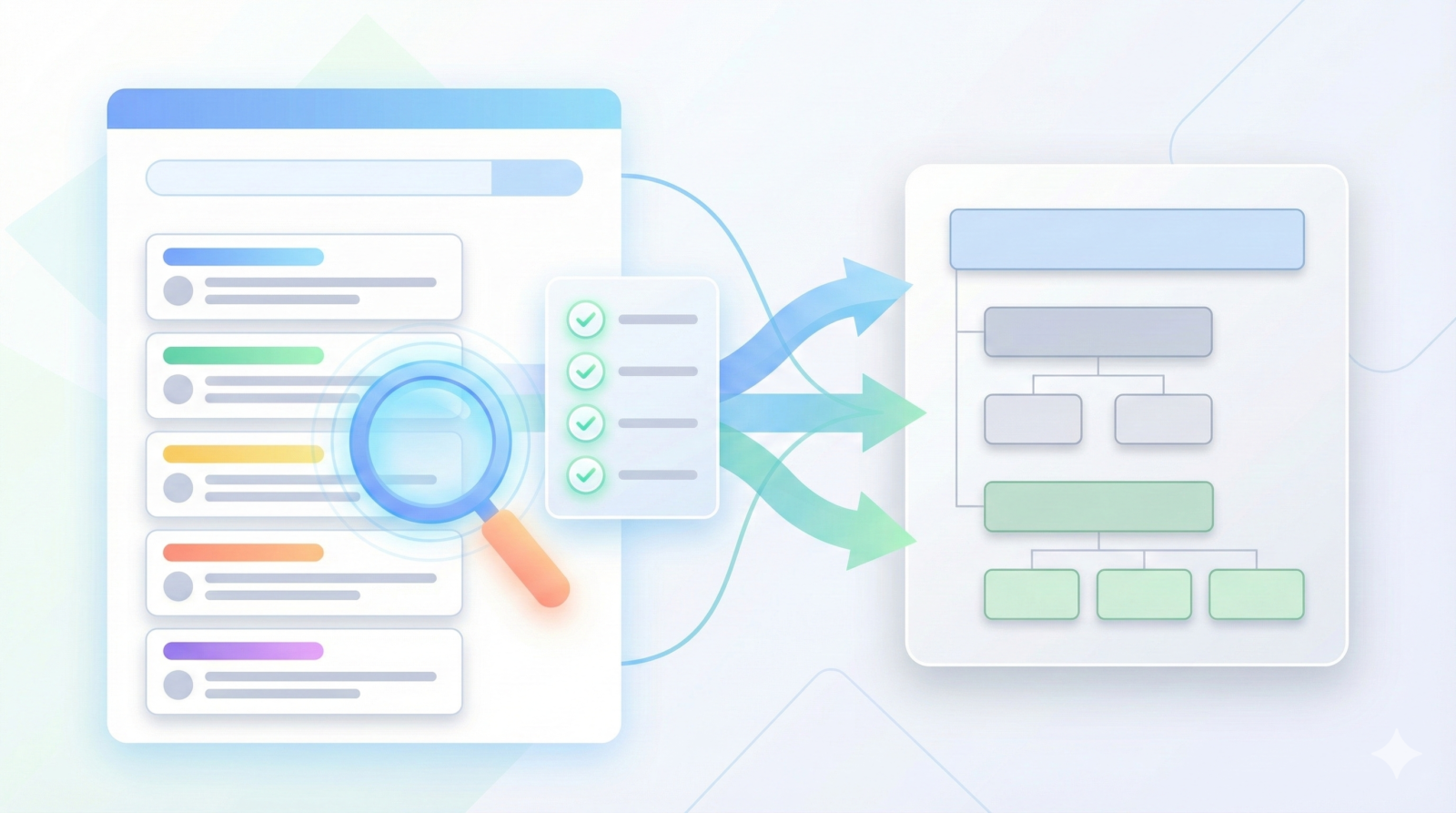
Step 5: Validate outline format by matching SERP expectations
This is the step most people skip, and it’s why their posts feel “off.”
5-Minute SERP Fit Check (do this before finalizing headings)
1) Open the top 5 results and label the dominant format:
– How-to / Checklist / Causes & Fixes / Cost Factors / Comparison / Definition
2) Count what shows up most (3+ out of 5 = “dominant SERP format”).
3) Note the “required blocks” that repeat:
– Quick answer? Tools list? DIY vs Pro? Warnings? FAQs? Local notes?
4) Extract 8–12 subtopics that appear in at least 2 results.
5) Decide your differentiator (local proof):
– “What we see locally” + “when it’s urgent” + “what to photograph before calling”
Output (paste into your brief):
– Dominant format:
– Required blocks:
– Subtopics to cover:
– Local differentiator blocks:
Intent and SERP patterns reward the content format readers already expect—so match your outline format to what dominates the top results.
For local services, these formats perform reliably:
- “How to…” troubleshooting steps
- “X causes + what to do”
- “Repair vs replace” decision framework
- “Cost factors” breakdown (without promising exact prices)
- Seasonal prep checklists
Pick the format before you finalize headings.
Step 6: Add local trust blocks (E-E-A-T without being cringe)
This is where you transform an AI outline into a local authority outline.
Google’s people-first guidance suggests evaluating content through “Who created it, How it was made, and Why it exists,” especially when automation is involved.
So add one or two “trust blocks” into your outline:
Trust Block Ideas
- “What we see in homes like yours (local pattern).”
- “A quick story from a recent service call (anonymous, no private details)”
- “What we check first (professional checklist).”
- “Common mistake we see homeowners make.”
- “What to photograph before you call (speeds up diagnosis)”
These are simple, but they signal experience.
Make AI leave placeholders for real experience (so you don’t forget):
Ask for 3–5 “Experience Inserts” inside the outline, like:
- Field note: what we typically find on arrival
- Common local factor: weather/housing age/materials
- Mistakes we see homeowners make
Step 7: Bake in conversion without turning the post into an ad
A TOFU post shouldn’t scream “BUY NOW.”
But it should provide a natural next step. For local services, the ethical CTA is usually:
- Inspection
- Estimate
- Consultation
- Safety check
- Maintenance plan
- Emergency call guidance
Use a “soft CTA ladder”:
- Self-check / checklist
- When to call a pro
- What happens when you call (set expectations)
- Optional: “If you want a reusable workflow for this, here’s a system.”
That last point is where product-led content fits nicely.
Two Data-Style Examples (Illustrative, Not “Stats”)
Here are two illustrative numeric examples to sanity-check the workflow:
Example 1: Lead math for a local service blog
A small HVAC company’s blog post gets 600 visits/month from local informational searches.
- If 2.5% of readers click to a service page: 600 × 0.025 = 15 clicks
- If 20% of those clicks become inquiries: 15 × 0.20 = 3 inquiries
- If you close 40% of inquiries: 3 × 0.40 = ~1 new job/month
One good post can produce “only” one job a month—and still be worth it if the job value is high or recurring.
Outlines matter because they improve the two conversion points you control:
- Time-on-page (did they get what they came for?)
- Clarity of next step (did they know what to do after?)
Example 2: Time savings with an AI workflow for blog planning
Manual outlining might take 60–90 minutes if you research, structure, and draft headings carefully.
With a structured AI workflow:
- Brief + prompt + edits: 20–30 minutes
If you publish 8 posts/month, and save even 45 minutes per post, that’s:
8 × 45 minutes = 360 minutes = 6 hours/month
Six hours is enough to add:
- Better photos from real jobs
- Stronger FAQs
- Internal links
- A seasonal service guide
The outline workflow doesn’t replace expertise—it buys you time to add it.
AI Blog Outline Examples for Local Services
Below are two outline patterns you can generate with an AI blog outline generator approach—then refine with human local context.
Example Outline #1: “Why is my water pressure suddenly low?”
H2: Quick answer (for the impatient)
- What low pressure usually means
- One immediate safe check
H2: Common causes of sudden low water pressure
- H3: A partially closed shutoff valve
- H3: Clogged aerator or showerhead
- H3: Hidden leak indicators (what to look for)
- H3: Pressure regulator issues (if applicable)
H2: DIY checks you can do in 10 minutes
- One-room vs whole-house test
- Simple checklist (no tools / basic tools)
H2: When low pressure is urgent
- Signs of an active leak
- Safety note (water + electrical areas)
H2: What a plumber checks (and why it’s fast)
- Diagnostic steps
- Typical fixes (without quoting prices)
H2: How to prevent it (local home context)
- Older pipes vs newer builds
- Seasonal factors (freezing / sediment / municipal work)
H2: Next steps
- If you want help, what to note before calling
- Optional inspection CTA
Example Outline #2: “How often should I service my HVAC system?”
H2: The short answer
- A simple schedule
- What changes by climate and usage
H2: What “service” actually includes
- Safety checks vs performance tune-up
- Why skipping matters
H2: Recommended servicing cadence
- H3: Once a year vs twice a year
- H3: Heat pump specifics
- H3: Older units
H2: Signs you shouldn’t wait for your next scheduled service
- Noisy operation
- Uneven cooling/heating
- Higher bills
- Humidity issues
H2: What homeowners can do between visits
- Filter schedule
- Thermostat habits
- Basic airflow checks
H2: Local considerations
- Dust/pollen seasons
- Extreme heat waves / cold snaps
- Common regional wear patterns
H2: When to repair vs replace
- Decision checklist
- How to talk to a technician (questions to ask)
H2: Next steps
- Maintenance plan vs one-off tune-up CTA
Step-by-Step AI Outlining: A Practical Prompt Pattern You Can Reuse
Here’s a compact pattern that works well for step-by-step AI outlining without turning your content into a prompt dump.
1) Ask AI to “interview” you first
This prevents generic outlines.
Prompt idea:
- “Ask me 8 questions to gather local context before outlining this post.”
2) Then request an outline with constraints
Constraints prevent hallucinations and fluff:
- “No fake stats”
- “Include DIY vs pro”
- “Include local variables.”
- “Include FAQ”
3) Finally, request an editor pass
Prompt idea:
- “Critique this outline: what’s missing for clarity, trust, and conversion?”
This three-pass structure is more reliable than one giant prompt.
Mistakes to Avoid (and How to Fix Them)
Mistake 1: The outline sounds “national,” not local
Symptom: It could apply to any city, any service provider.
Fix: Add one “local reality” section and one “what we commonly see” section.
Mistake 2: AI invents confidence or specifics you can’t support
Symptom: It claims exact costs, timeframes, or “studies show…”
Fix: Add a hard constraint: “If uncertain, present ranges or factors, not specifics.”
Mistake 3: The outline answers the question but misses the business goal
Symptom: Helpful post, zero leads.
Fix: Add a “next step ladder” section (self-check → when to call → what to expect).
Mistake 4: Keyword obsession ruins readability
Symptom: Repetitive phrasing, awkward headings.
Fix: Use the focus keyword where it matters (H1, early intro, one H2, meta), then switch to natural language.
Google’s Search Essentials encourages using terms people search for in prominent places (like titles and headings), but that’s different from stuffing the exact phrase into every spot.
Mistake 5: You outline before you understand intent
Symptom: You wrote a “how-to,” but readers wanted a quick diagnostic, or vice versa.
Fix: Do a fast SERP scan and align the format accordingly.
Local Service Blogging + AI: A Reality Check
AI can accelerate your process—but it doesn’t “know” your market.
Semrush’s 2025 guidance notes a practical limitation: AI chatbots don’t actually know what users search in Google, but they can suggest ideas based on your prompt inputs—so you still need real-world validation.
That’s the correct mindset for local services:
- Use AI to propose structure, angles, FAQs, and checklists
- Use your business reality to validate what’s accurate, safe, and locally relevant
- Use your editing brain to remove anything that sounds invented
Also, remember local ranking factors are not just “content.” Local visibility often depends on proximity, relevance, and prominence signals (and your broader local SEO foundations). BrightLocal’s local SEO checklist (updated for 2025) breaks these pillars down clearly.
Your blog outline should support that ecosystem:
- Internal links to relevant service pages
- Consistent topical coverage
- Useful FAQs that match real customer questions
- Trust blocks that reduce skepticism
Turning This Workflow into a Reusable Prompt System
After you run this workflow a few times, you’ll notice the real bottleneck isn’t knowledge—it’s consistency.
You’ll create one good outline… then forget the exact prompt that produced it. Or you’ll lose the “local context” checklist. Or you’ll rebuild the wheel every week.
That’s where a structured prompt system (like those in Blog Writing Prompt Systems) becomes useful—not as a shortcut, but as a way to preserve your best thinking.
You don’t need a “magic prompt.” You need a repeatable system that preserves your best thinking:
Your local question bank, your trust blocks, your DIY-vs-pro safety notes, and your CTA ladder.
If you publish only once in a while, saving a single strong outline template may be enough.
But if you publish weekly (or work with a tiny team), a prompt system helps quality stay consistent—so you don’t rebuild the wheel every time.
Smart AI Blog Outline Prompts for Small Business Sites is one example of that kind of system: it standardizes the brief → outline → trust inserts → FAQ flow without stripping out your local expertise.
In practice, systems like this are most helpful when:
- You publish regularly and don’t want quality to fluctuate,
- You have a small team and need a shared process,
- You want every outline to include the same trust blocks, FAQs, and conversion structure.
Summary & Next Steps
Key takeaways
- A strong outline is the difference between “content” and content that converts.
- Local service posts must balance clarity, trust, and a natural next step.
- AI helps most when you feed it local reality inputs and enforce constraints.
- Match the format to the intent before you finalize the headings.
- Add local trust blocks to make the post feel experienced, not generic.
Action steps you can do this week (TOFU-friendly)
- Pick one service and list 10 real customer questions you hear repeatedly.
- Turn one question into a one-page brief (audience, local context, danger zone, CTA).
- Prompt AI to generate 3 outline options, then choose the one that best matches the intent.
- Add two trust blocks: “what we see locally” + “DIY vs call a pro.”
- Save your final prompt + outline structure as a reusable template for the next post.
This guide focuses on the outline stage for local services—because that’s where most posts win or lose. If you want the complete end-to-end system (topic selection → brief → outline → block drafting → two-pass editing → on-page SEO → publish), follow the Pillar guide here: Step-by-step AI Blog Writing Workflow for Small Business Owners (From Idea to Publish).
FAQs
How do I use AI to draft blog post outlines for local services without sounding generic?
Feed AI local context (common customer questions, seasonal patterns, service boundaries) and require a “local reality” section in the outline. Then add one trust block from real experience—what you see in homes or businesses in your area.
Can I do this without AI?
Yes. The same workflow works manually: brief → structure → headings → FAQs → edits. AI mainly speeds up the first draft of structure so you can spend more time on accuracy and local specificity.
How much should I rely on AI vs my own judgment?
Use AI for structure and idea generation, but rely on your judgment for truth, safety, and relevance. If something feels too confident, too specific, or not locally accurate, revise it or remove it.
What’s the best blog format for local service businesses?
“How-to” guides, diagnostic “causes + fixes,” checklists, and decision frameworks (“repair vs replace”) tend to work well. The best choice depends on the search intent you see in the current top results for your keyword.
How do I make sure my outline supports SEO without keyword stuffing?
Place your primary keyword naturally in the H1, early introduction, one H2, and metadata. Use related phrases and natural language elsewhere. Focus on clarity and completeness; keywords should follow meaning, not replace it.
Should local service blog posts link to service pages?
Usually yes—when it’s helpful. Link where a reader would logically want the next step (booking, inspection, estimate), and keep the post informational-first so the link feels like guidance, not an ad.
REFERENCES
Google Search Central – Creating Helpful, Reliable, People-First Content
Google Search Central – Google Search Essentials
Semrush – How to Use AI for a Content Strategy That Drives Results (Dec 2025)
How To Write a Blog Post Outline: A 9-Step Guide for 2025 [Free Template]
The Complete Local SEO Checklist 2025 + Downloadable Template