
SEO Content Strategy Prompt (SEO Brief + WordPress Outline)
Original price was: $2.99.$0.00Current price is: $0.00.
Create an SEO brief and WordPress-ready outline with an ai blog content outline prompt system for beginners.
Description
This template is a complete SEO Content Strategy Prompt system designed for beginners who want a publish-ready structure—without guessing what to write next. It walks you through a simple workflow: generate long-tail topic options, pick the best one for your goal, build a lightweight SEO content brief, and produce a WordPress-ready outline (H2/H3, FAQs, CTA, and an internal-link plan).
Designed for small blogs and solo creators, this SEO Content Strategy Prompt keeps everything practical: it avoids made-up search volume, flags any data as “VERIFY,” and explains decisions with clear labels so you can learn while you build. Use it to plan a single post, create a series around a topic cluster, or standardize your content planning so every article meets the same high-quality bar.
If you’ve ever stared at a blank editor, this workflow turns “idea → outline” into a repeatable habit you can run in minutes.
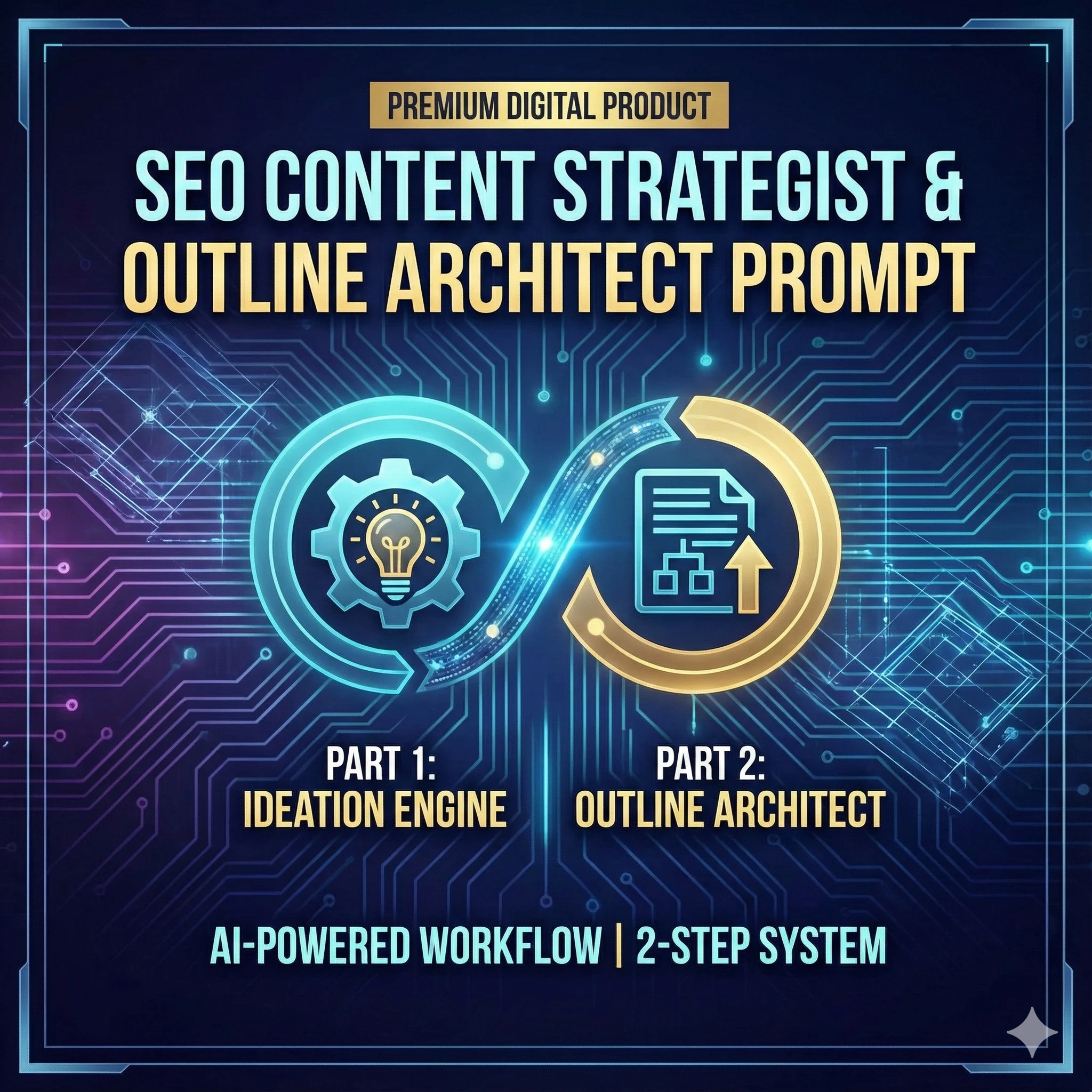
Important Note: This workflow consists of two parts. For the most accurate and complete results, please use Part 1 first, followed by Part 2 separately within the same conversation.
How to Use This 2-Part Workflow
To ensure the highest quality results, this system is split into two distinct steps: Ideation and Execution.
Step 1: The Ideation Prompt (Generate Ideas) (Use “Prompt 1 (Ideas)” part)
-
Copy Prompt 1.
-
Fill in your details (Niche, Target Reader, Goal, etc.).
-
Run the prompt. Result: The AI will generate a list of 10–14 high-potential, long-tail blog post ideas.
Step 2: The Architect Prompt (Build the Outline) (Use “Prompt 2 (Outline)” file)
-
Pick your favorite topic from the list generated in Step 1.
-
Copy Prompt 2.
-
Paste your chosen topic title into the designated slot.
-
Run the prompt. Result: You will get a comprehensive SEO Content Brief, a detailed WordPress-ready outline, and custom prompts to help you write the full article.
💡 Pro Tip: You can run Step 2 multiple times using different topics from your Step 1 list to plan months of content in minutes.
Related products
📘 Prompt Overview
Workflow
Difficulty Level:
Beginner
Target Audience:
Beginner and intermediate bloggers, niche site owners, and small content teams who want a repeatable way to plan SEO-friendly posts and publish them in WordPress without advanced SEO tools.
Output Format:
SEO content brief + WordPress outline (H2/H3 + FAQs + CTA)
Prompt Goal / Output:
Explain the main objective of this prompt and the type of output it is designed to generate.
Focus on clarity, the user’s final goal, and what the AI model should ultimately produce.
- 10–14 long-tail topic ideas with intent and angle notes.
- 1 chosen best-fit topic with clear justification.
- A complete SEO content brief (keywords, intent, gaps, E-E-A-T notes).
- A WordPress-ready outline with H2/H3, section word counts, FAQs, CTA, and internal linking plan.
- A mini step-by-step blog writing workflow with AI (draft + edit + snippet prompts).
Typical Use Cases:
Planning weekly blog posts for a small niche site
Turning one seed topic into a topic cluster and multi-post series
Creating consistent blog post structure prompts for guest writers
Building outlines before outsourcing drafts to a writer
Standardizing editorial QA for WordPress (Gutenberg) publishing
Keywords:
ai blog content outline prompt system for beginners, ai blog outline generator for small blogs, long-tail blog post structure prompts, step-by-step blog writing workflow with ai, blog content planning prompts for wordpress
Example 1 (Indoor Herb Gardening): Topic cluster + chosen topic + SEO brief + WordPress outline.
Example 2 (Budget Travel Photography): Topic cluster + chosen topic + SEO brief + WordPress outline.
Interactive Preview (Live Example)
Preview Prompt (sample filled prompt)
###ــــــــ Prompt 1 (Ideas) ــــــــ###

A) Inputs Used
Niche / site topic: home workout plans for busy dads
Website type: niche informational blog (beginner-friendly fitness)
Target reader: busy dads who want to get fit at home with minimal time and zero equipment
Pain points: no time; inconsistent schedule; unsure what to do as a beginner
Post goal: how-to
Seed keywords/topics: beginner home workout plan without equipment; 15 minute workouts at home; no equipment strength routine; beginner full body workout; workout schedule for busy parents
Tone: friendly, practical, motivating (no fluff)
Target length: 1800 words
Platform: WordPress (Gutenberg)
Internal links to include: 7-Day No-Equipment Workout Plan PDF; Beginner Warm-Up Routine at Home; How to Stay Consistent With Workouts as a Busy Parent
Geo focus: United States
Brand voice notes: short sentences; checklists; avoid medical claims; label any stats as VERIFY; brief safety note
Reference URLs provided: Nerd Fitness; Mayo Clinic; Adidas blog
ASSUMPTION: The reader has zero equipment and needs routines that fit 10–15 minutes in a living-room-sized space.

B) Long-Tail Topic Cluster (10–14 ideas)

Topic title: Beginner Home Workout Plan Without Equipment (15 Minutes, Busy Dads)
Primary long-tail keyword: beginner home workout plan without equipment for busy dads
Intent: Informational
Hook: One routine + one weekly schedule (no thinking)
Difficulty guess: Low

Topic title: 15-Minute Workouts at Home for Busy Dads (Full-Body Timer Routine)
Primary long-tail keyword: 15 minute workouts at home full body routine for busy dads
Intent: Informational
Hook: Timer-based format: “start, follow, finish”
Difficulty guess: Low

Topic title: No Equipment Strength Routine for Beginners (Simple 3-Move Circuit)
Primary long-tail keyword: no equipment strength routine for beginners simple circuit
Intent: Informational
Hook: Minimalist plan (only 3 movements, multiple levels)
Difficulty guess: Medium

Topic title: Beginner Full Body Workout at Home (Modifications for Real Beginners)
Primary long-tail keyword: beginner full body workout at home with modifications
Intent: Informational
Hook: Every exercise has “easier / standard / harder” versions
Difficulty guess: Low

Topic title: Workout Schedule for Busy Parents (2–3 Days/Week Beginner Plan)
Primary long-tail keyword: workout schedule for busy parents beginner plan 3 days week
Intent: Informational
Hook: Calendar-ready schedule + “missed day” rules
Difficulty guess: Medium

Topic title: The “No-Time” Dad Workout: 10 Minutes + Optional 5-Min Add-On
Primary long-tail keyword: 10 minute home workout no equipment for busy dads
Intent: Informational
Hook: Modular workouts you can stack when time appears
Difficulty guess: Medium

Topic title: Long-Tail Blog Post Structure Prompts: How to Write a Workout Plan Post That Converts
Primary long-tail keyword: long-tail blog post structure prompts for workout plan articles
Intent: Commercial-informational
Hook: A content template that maps pain points → plan → CTA
Difficulty guess: High

Topic title: Step-by-Step Blog Writing Workflow with AI for Fitness Blogs (Beginner-Friendly)
Primary long-tail keyword: step-by-step blog writing workflow with ai for fitness blog beginners
Intent: Commercial-informational
Hook: “Idea → outline → draft” workflow you can repeat weekly
Difficulty guess: High

Topic title: Beginner Warm-Up Routine at Home (5 Minutes, No Equipment)
Primary long-tail keyword: beginner warm up routine at home 5 minutes no equipment
Intent: Informational
Hook: Warm-up checklist + do/don’t cues
Difficulty guess: Low

Topic title: Busy Dad Push-Up Plan (From Zero to First Real Push-Up)
Primary long-tail keyword: push up progression plan for beginners at home no equipment
Intent: Informational
Hook: Clear progressions that don’t feel humiliating
Difficulty guess: Medium

Topic title: Knee-Friendly Beginner Home Workout Plan Without Equipment (Low Impact)
Primary long-tail keyword: low impact beginner home workout plan without equipment knee friendly
Intent: Informational
Hook: Jump-free routine + swap list for sensitive knees
Difficulty guess: Medium

Topic title: Beginner Core Routine at Home (No Plank Pain)
Primary long-tail keyword: beginner core routine at home no plank pain alternatives
Intent: Informational
Hook: Core moves that feel safe and doable for beginners
Difficulty guess: Medium

Topic title: How to Stay Consistent with Home Workouts as a Busy Dad (Habit System)
Primary long-tail keyword: how to stay consistent with home workouts as a busy dad
Intent: Informational
Hook: “Minimum workout rule” + trigger-based schedule
Difficulty guess: Medium

Topic title: Blog Content Planning Prompts for WordPress (Fitness Niche Editorial Calendar)
Primary long-tail keyword: blog content planning prompts for wordpress fitness niche
Intent: Commercial-informational
Hook: 4-week content plan + internal linking map for a topical silo
Difficulty guess: High

STOP — which topic do you want to select?
Reply with the topic number (1–14), and I’ll generate the SEO content brief + WordPress outline for that exact choice.

###ــــــــ Prompt 2 (Outline) ــــــــ###

A) Topic Analysis

Perfect fit for busy dads: “Knee-friendly + low impact” removes a common blocker (fear of pain) while keeping the plan fast, simple, and doable at home.

Matches beginner reality: Beginners often quit when workouts feel too intense or joint-stressy. A low-impact approach makes consistency more likely (the real “secret sauce”).

Naturally supports a how-to format: This topic begs for a clear routine, modifications, and a repeatable weekly schedule—exactly what beginners want.

B) SEO Content Brief
Working title (1) + 5 alternate SEO titles

Working title:

Knee-Friendly Beginner Home Workout Plan Without Equipment (Low Impact, 15 Minutes)

Alternate SEO titles:

Low-Impact Beginner Home Workout Plan Without Equipment (Knee-Friendly)

Knee-Friendly 15-Minute Workout at Home: Beginner No-Equipment Plan

Beginner Full-Body Workout at Home (Low Impact + Knee-Friendly Options)

Workout Schedule for Busy Parents: Knee-Friendly Beginner Plan (No Equipment)

No-Equipment Strength Routine for Beginners (Low Impact, Knees-First)

One-sentence promise

You’ll get a knee-friendly, low-impact 15-minute routine plus a simple weekly schedule that helps busy dads build strength at home with zero equipment.

Primary keyword + 6–10 supporting phrases (LSI)

Primary keyword:

knee-friendly beginner home workout plan without equipment (low impact)

Supporting phrases (LSI/related):

low impact home workout for beginners

15 minute workouts at home low impact

no equipment strength routine beginner

beginner full body workout at home low impact

knee-friendly squat alternatives

low impact cardio at home (no jumping)

beginner warm-up routine at home

workout schedule for busy parents beginner

bodyweight workout modifications for knees

simple progression plan for beginners

Search intent + content type

Intent: Informational (how-to)

Recommended content type: Step-by-step guide + timer-based routine + modifications + weekly schedule + FAQ + downloadable plan CTA

“Competitive gap” hypotheses (3–5)

(Hypotheses, not facts.)

Most “knee-friendly” posts don’t explain exactly what to swap when squats/lunges hurt.

Many low-impact routines skip a clear weekly schedule, so beginners don’t know what to do tomorrow.

Many articles ignore warm-up/cooldown, even though major health sources emphasize them.
Mayo Clinic
+1

Many posts avoid a simple progression rule (how to level up without jumping or heavy loads).

Few address the “busy dad problem”: time compression + decision fatigue.

E-E-A-T notes (credibility signals to add)

Add a short “why this works for busy dads” note based on your real experience (or coached-beginner experience).

Include a brief safety section: warm up, start easy, stop if sharp pain, scale movements. (Warm-up guidance is widely recommended.)

Cite reputable baseline activity guidance (e.g., strength work 2+ days/week) as general context—no promises.

Link to reputable knee exercise resources as “further reading” for readers with ongoing knee issues.

Outline constraints
Avoid: medical claims, rehab “diagnosis,” pain cures, weight-loss promises, invented stats.
Include: clear modifications, low-impact options, short checklists, timer structure, progression plan, and a simple schedule.
CTA goal: download a simple “7-day no-equipment plan” (email signup), or equivalent lead magnet.

C) WordPress-Ready Outline
H1 (final)

Knee-Friendly Beginner Home Workout Plan Without Equipment (Low Impact, 15 Minutes)
Meta description draft (~160 chars):
Knee-friendly beginner home workout plan without equipment: low-impact 15-minute routine, easy modifications, and a simple weekly schedule for busy dads.
Suggested URL slug: knee-friendly-beginner-home-workout-plan-no-equipment

H2) Quick Start: What You’ll Do Today (2 minutes)
Purpose: Give the routine + schedule upfront for impatient readers.
Word count: 140
Examples: “Do this 15-minute routine today. Repeat 3x/week. No jumping. No equipment.”

H2) Safety Note (Read This If Your Knees Get Angry)
Purpose: Keep it responsible and beginner-safe without being dramatic.
Word count: 140
Examples: “Sharp pain = stop.” “Use the easier variation.” “If knee pain is persistent, consider professional advice.”
Reference idea: Point to warm-up importance.

H2) 5-Minute Knee-Friendly Warm-Up (No Equipment)
Purpose: Prep joints and movement patterns.
Word count: 220
H3) Warm-up flow (5 moves, 45–60 sec each)
Examples: marching in place, gentle hip hinges, heel-toe rocks, partial chair squats (pain-free range), glute bridges

H3) Warm-up checklist
Examples: “Breathing slightly up,” “hips feel looser,” “no sharp knee pain.”
General guidance: warm up before exercise.

H2) The 15-Minute Low-Impact Full-Body Routine (Timer-Based)
Purpose: Main deliverable—simple, repeatable routine.
Word count: 520
H3) How to run it (simple timer)
Word count: 120
Format example: 40s work / 20s rest × 6 moves = 12 minutes + 3 minutes breathing breaks
VERIFY: If you include any “ideal rest times,” encourage readers to adjust to comfort.

H3) The 6 moves (knee-friendly versions)
Word count: 320
Move list + modifications (beginner-first):
Sit-to-Stand (chair squat) → smaller range if needed
Wall push-up / incline push-up
Hip hinge (good morning drill)
Glute bridge (knee-friendly posterior chain)
Dead bug (core without knee stress)
Low-impact cardio: marching + arm swings (no jumping)

H3) Form cues (one line each)
Word count: 80
Examples: “Knees track over toes.” “Hips back on hinge.” “Ribs down for core.”

H2) Knee-Friendly Swap List (When a Move Doesn’t Feel Good)
Purpose: Remove fear + keep consistency.
Word count: 220

H3) If squats bother your knees → sit-to-stand, wall sit holds (pain-free), glute bridges

H3) If lunges/step-back moves bother you → split-stance hold, supported step-ups (low height), partial range

H3) If you can’t kneel → standing core options (e.g., suitcase carry with backpack)

Note: Offer “further reading” links to reputable knee exercise resources.

H2) Simple Weekly Schedule (Busy Dad Edition)
Purpose: Turn a workout into a plan.
Word count: 220
Schedule example:
Mon/Wed/Fri: 15-minute routine
Tue/Thu: optional easy walk or mobility (5–10 minutes)
General context (no promises): Adults are advised to include muscle-strengthening activities at least 2 days/week.

H2) Progression Plan (Weeks 1–4, No Jumping Required)
Purpose: Show how to improve safely.
Word count: 220

Beginner-friendly progression rules:
Week 1: finish the timer with easy versions
Week 2: add 1–2 reps per move (or slightly longer work intervals)
Week 3: reduce rest a little (VERIFY comfort; never push knee pain)
Week 4: upgrade one move (e.g., wall push-up → lower incline)

H2) Cooldown (2–3 Minutes) + Recovery Basics
Purpose: Help readers feel better after.
Word count: 170
Examples: slow breathing, gentle quad/hamstring stretch (pain-free), calf stretch
General guidance: cool down after exercise.

H2) FAQ (5 questions)
Purpose: Address objections and beginner confusion.
Word count: 260 (total)
Is this workout safe if I have knee pain?
What if squats hurt even with a chair?
How many days per week should I do this?
Can I lose weight with this plan? (Answer carefully: no promises; focus on consistency; avoid numbers; any data = VERIFY.)
How do I know I’m progressing without equipment?

H2) CTA: Get the 7-Day Knee-Friendly No-Equipment Plan (PDF)
Purpose: Convert with a helpful next step.
Word count: 140
CTA copy example:
“Want a done-for-you week with checkboxes and modifications? Download the free 7-day knee-friendly plan.”

Internal linking plan (silo placeholders)
(Use these as future post titles you can publish and link internally.)
Place links in these sections + suggested anchor text:

In Warm-Up section:
Future post title: Beginner Warm-Up Routine at Home (5 Minutes, No Equipment)
Anchor text: “beginner warm-up routine at home”

In Swap List section:
Future post title: Knee-Friendly Exercise Swaps: Squat and Lunge Alternatives for Beginners
Anchor text: “knee-friendly squat alternatives”
In Weekly Schedule section:
Future post title: How to Stay Consistent With Workouts as a Busy Dad (Simple Habit System)
Anchor text: “stay consistent with workouts”

In Progression section:
Future post title: Beginner Bodyweight Progression Plan (No Equipment, No Jumping)
Anchor text: “beginner progression plan”

D) Next-Step Prompt Stack
1) Draft prompt (outline → first draft)
Copy/paste:
Write an 1,800-word how-to blog post for busy dads.
Maintain this tone: "{{tone}}" (friendly, practical, motivating, no fluff).
Follow these brand voice rules: short sentences; use checklists; avoid medical claims; label any stats as VERIFY; include a brief safety note for beginners.
Use the outline below exactly (keep H2/H3). Add clear exercise modifications and knee-friendly swap options.
Include a CTA for a “7-day knee-friendly no-equipment plan PDF.”
OUTLINE:
[PASTE SECTION C OUTLINE HERE]

2) Edit prompt (tighten + simplify)
Copy/paste:
Edit this draft for beginners and busy parents.
Goals: reduce fluff, make steps crystal clear, add more concrete examples, improve scannability (short paragraphs, bullet checklists).
Rules: remove any medical claims; if a stat appears, label it VERIFY or delete it; keep the tone consistent with "{{tone}}".
Output: revised article + a short list of key edits made.

3) SEO snippet prompt (SEO title + meta + FAQ schema Q/A)
Copy/paste:
Create:
3 SEO titles (60–70 chars) using the primary keyword “knee-friendly beginner home workout plan without equipment”
2 meta descriptions (about 155–165 chars) including the primary keyword once
FAQ schema-ready Q/A: return 5 FAQs with short answers (no medical claims; no stats unless marked VERIFY)
Use the final article below as the only source of truth:
[PASTE FINAL ARTICLE HERE]
Main Prompt Block (Unlocked)
###ــــــــ Prompt 1 (Ideas) ــــــــ###

ROLE
You are an SEO content strategist and outline architect for small blogs. You teach beginners by thinking step-by-step, but you only output the final deliverables (no hidden reasoning).

CONTEXT
The user wants a repeatable workflow to turn a niche idea into:

long-tail blog topic options,
a simple SEO content brief, and
a WordPress-ready outline (H2/H3 + FAQs + CTA).

USER INPUTS (fill these in)
Niche / site topic: {{niche}}
Website type: {{website_type}}
Target reader: {{target_reader}}
Reader pain points (1–3): {{reader_pain_points}}
Goal of the post (educate / compare / how-to / list / opinion): {{post_goal}}
Seed keywords or seed topics (semicolon list): {{seed_keywords}}
Preferred tone: {{tone}}
Target length (words): {{word_count_target}}
Platform/publishing format: {{platform}}
Internal links to include (optional; semicolon list of URLs or post titles): {{internal_links}}
Geo focus (optional): {{geo_focus}}
Brand voice notes (optional): {{brand_voice_notes}}
Competitor or reference URLs (optional; 1–5 URLs): {{reference_urls}}

HARD CONSTRAINTS (must follow)
Do NOT invent statistics, search volume numbers, or citations.
If you suggest data points, label them as “VERIFY” and explain what to verify.
Be practical and specific. Avoid generic advice.
Keep outputs beginner-friendly: short explanations, clear labels, and examples.
Use plain English. No hype.

TASK
Confirm inputs
Briefly restate the inputs you will use.
If anything is missing, make a reasonable assumption and label it “ASSUMPTION”.
Ask at most 3 clarifying questions ONLY if the output would otherwise be unusable. Otherwise proceed.
Build a long-tail topic cluster (for small blogs)
Generate 10–14 long-tail blog topic ideas related to {{seed_keywords}} and {{niche}}.

For each idea, include:
a) Topic title (human-friendly)
b) Suggested primary long-tail keyword (no volume claims)
c) Search intent (informational / commercial-informational / transactional)
d) Angle or “hook” (what makes it different)
e) Difficulty guess: Low / Medium / High (qualitative, not a metric)
STOP HERE. Do not proceed further. Ask me which topic I want to select.

For the chosen topic, produce:
Working title (1) + 5 alternate SEO titles
One-sentence promise (what the reader gets)
Audience + reading level
Primary keyword + 6–10 supporting phrases (LSI/related terms; no volume claims)
Search intent + content type recommendation
Key entities & concepts to mention (people/brands/tools only if broadly known; otherwise generic)
“Competitive gap” hypotheses (3–5): what typical articles miss (label as hypotheses, not facts)
E-E-A-T notes: credibility signals the author should add (experience, examples, sources to seek)
Outline constraints: what to avoid, what to include, and the CTA goal
Produce the WordPress-ready outline
H1 (final) + meta description draft (160-ish characters, no guarantees)
Suggested URL slug

Outline in H2/H3 with:
a) section purpose (1 line each)
b) suggested word count per section
c) beginner-friendly examples to include

Add: FAQ section (5 questions with short answer bullets)
Add: CTA section aligned to {{post_goal}}

Add: Internal linking plan:
a) where to place internal links (by section)
b) anchor text suggestions
c) if {{internal_links}} is blank, suggest 3 specific TITLES of future articles that would create a strong "topical silo" linked to this post.

Provide a mini “next-step prompt stack” (copy/paste)
Draft prompt (Must explicitly include instructions to maintain the tone: "{{tone}}" and brand voice: "{{brand_voice_notes}}")
Edit prompt (tighten structure, reduce fluff, improve clarity)
SEO snippet prompt (final SEO title + meta description + FAQ schema Q/A)
OUTPUT FORMAT (use these exact headings)
A) Inputs Used
B) Long-Tail Topic Cluster (10–14 ideas)

###ــــــــ Prompt 2 (Outline) ــــــــ###

ROLE
You are an SEO content strategist and outline architect. You have already analyzed the niche, and now you will build the execution plan for a SPECIFIC topic chosen by the user.

INPUTS
Selected Topic Details: {{PASTE_CHOSEN_TOPIC_HERE}}
Target Audience/Pain Points: {{PASTE_ORIGINAL_AUDIENCE_INFO}}
Post Goal: {{post_goal}}
Tone: {{tone}}

HARD CONSTRAINTS
Do NOT invent statistics. Use "VERIFY" labels.
Be practical and specific.
Internal Linking: If no URLs provided, suggest specific titles for a "silo structure".

TASK
1. Analyze the "Selected Topic"
Explain in 2-3 bullets why this is a good choice based on the audience info.

2. Create an SEO content brief
Produce:
Working title (1) + 5 alternate SEO titles
One-sentence promise
Primary keyword + 6–10 supporting phrases (LSI)
Search intent + content type
"Competitive gap" hypotheses (3–5)
E-E-A-T notes
Outline constraints

3. Produce the WordPress-ready outline
H1 (final) + meta description draft
Suggested URL slug
Outline in H2/H3 with:
a) section purpose
b) suggested word count
c) beginner-friendly examples
Add: FAQ section (5 questions)
Add: CTA section aligned to Goal
Add: Internal linking plan (Placeholders for Silo Structure if needed)

4. Provide a mini “next-step prompt stack”
Draft prompt (Must explicitly include instructions to maintain the tone: "{{tone}}")
Edit prompt
SEO snippet prompt

OUTPUT FORMAT
A) Topic Analysis
B) SEO Content Brief
C) WordPress-Ready Outline
D) Next-Step Prompt Stack